
India New GST Trend: Boon or Burden for the Economy?
India’s tax system has undergone one of the most ambitious reforms in recent decades with the Goods and Services Tax (GST). While it promised simplicity, transparency, and uniformity, the reality is still debated. Now, with India New GST Trend, conversations have shifted — is this reform truly empowering businesses and consumers, or is it creating fresh challenges that weigh down growth? This article dives into the features, impact, myths, and realities of GST’s latest shift.
Features of India’s New GST Trend
The recent changes in GST policies are more than just tax revisions; they are structural transformations shaping the future of business transactions.
Key Features
-
Unified Compliance: A single platform for multiple tax filings reduces paperwork.
-
E-Invoicing Expansion: Businesses above specific turnover limits must adopt digital invoicing for transparency.
-
Input Tax Credit Adjustments: Clearer rules for claiming credits, but stricter checks to prevent misuse.
-
Sector-Specific Changes: Tweaks in slabs for industries like hospitality, online gaming, and renewable energy.
These updates redefine how businesses and individuals navigate taxation under India New GST Trend.
Good or Bad? The Double-Sided Impact
Like any reform, GST’s new trajectory carries both positives and negatives.
The Good
-
✅ Encourages digitization in taxation.
-
✅ Builds a stronger tax compliance culture.
-
✅ Expands government revenue, aiding infrastructure and welfare.
The Bad
-
❌ Compliance burden on small businesses with limited resources.
-
❌ Complexities in sector-specific rules confuse traders.
-
❌ Short-term disruptions as businesses adapt to frequent changes.
So, India New GST Trend is neither fully good nor fully bad — it’s a balancing act between efficiency and adaptation.
Myth or True? Busting Common Perceptions
When it comes to GST, myths spread faster than facts. Let’s separate them.
Myth 1: GST is a single flat tax
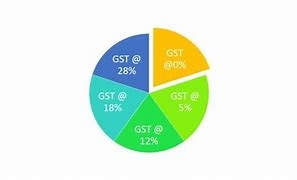
🚫 Wrong. Multiple slabs (0%, 5%, 12%, 18%, 28%) still exist, making it layered rather than flat.
Myth 2: Only large businesses are affected
🚫 Wrong. Even small businesses face compliance obligations under GST registration rules.
Myth 3: GST has made goods cheaper everywhere
🚫 Wrong. While some sectors saw price drops, others witnessed hikes due to revised slabs.
The truth is, India New GST Trend is about continuous evolution, not a one-time miracle fix.
Pricing & Revenue Specifications
Every reform under GST carries pricing implications — not just for businesses but also for consumers.
Specifications That Matter
-
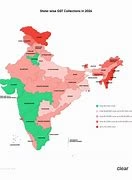
Government Revenue Growth: GST collections are breaking records month after month.
-
Consumer Impact: Essential goods remain in lower slabs, while luxury items attract higher taxes.
-
Business Impact: Compliance cost adds to pricing, especially for MSMEs.
This dual impact makes India New GST Trend both a revenue powerhouse and a cost challenge.
User-Friendly or Compliance-Heavy?
While GST promised simplicity, the current structure feels more like a mixed bag.
User-Friendly Elements
-
Online filing portals reduce manual hassles.
-
Input Tax Credit ensures businesses avoid double taxation.
-
Automation reduces corruption opportunities.
Compliance-Heavy Realities
-
Frequent policy updates mean constant learning.
-
Small businesses struggle with e-invoicing requirements.
-
Penalties for non-compliance remain harsh.
Thus, the new GST landscape is friendly for digitally equipped businesses but burdensome for traditional players.
The Future of India’s New GST Trend
Where does this trend lead India in the coming years?
-
📈 Greater Formalization: More businesses entering the tax net.
-
🌍 Global Benchmarking: India aligning its taxation system with international best practices.
-
🔄 Continuous Evolution: Regular tweaks expected as the government balances growth and compliance.
The future of India New GST Trend looks progressive, but only if reforms focus on ease for small and medium businesses.
Conclusion
GST was envisioned as a game-changer, and it has indeed reshaped India’s financial ecosystem. But the truth lies in balance: India New GST Trend is both a boon and a burden. For consumers, it brings transparency; for businesses, it brings both opportunity and responsibility. Myths aside, the evolving GST system is here to stay, and its success will depend on how quickly businesses adapt to its rhythm.