
India New GST Trend: Boon or Burden for the Economy?

India New GST Trend: Boon or Burden for the Economy?

NBTV LIFESTYLE

India’s tax system has undergone one of the most ambitious reforms in recent decades with the Goods and Services Tax (GST). While it promised simplicity, transparency, and uniformity, the reality is still debated. Now, with India New GST Trend, conversations have shifted — is this reform truly empowering businesses and consumers, or is it creating fresh challenges that weigh down growth? This article dives into the features, impact, myths, and realities of GST’s latest shift.


Features of India’s New GST Trend

The recent changes in GST policies are more than just tax revisions; they are structural transformations shaping the future of business transactions.

Key Features
  • Unified Compliance: A single platform for multiple tax filings reduces paperwork.

  • E-Invoicing Expansion: Businesses above specific turnover limits must adopt digital invoicing for transparency.

  • Input Tax Credit Adjustments: Clearer rules for claiming credits, but stricter checks to prevent misuse.

  • Sector-Specific Changes: Tweaks in slabs for industries like hospitality, online gaming, and renewable energy.

These updates redefine how businesses and individuals navigate taxation under India New GST Trend.


Good or Bad? The Double-Sided Impact

NBTV LIFESTYLE

Like any reform, GST’s new trajectory carries both positives and negatives.

The Good
  • ✅ Encourages digitization in taxation.

  • ✅ Builds a stronger tax compliance culture.

  • ✅ Expands government revenue, aiding infrastructure and welfare.

The Bad
  • ❌ Compliance burden on small businesses with limited resources.

  • ❌ Complexities in sector-specific rules confuse traders.

  • ❌ Short-term disruptions as businesses adapt to frequent changes.

So, India New GST Trend is neither fully good nor fully bad — it’s a balancing act between efficiency and adaptation.


Myth or True? Busting Common Perceptions

NBTV LIFESTYLE

When it comes to GST, myths spread faster than facts. Let’s separate them.

Myth 1: GST is a single flat tax

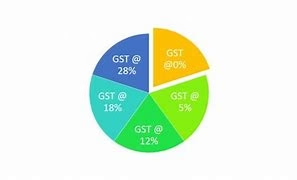
🚫 Wrong. Multiple slabs (0%, 5%, 12%, 18%, 28%) still exist, making it layered rather than flat.

Myth 2: Only large businesses are affected

🚫 Wrong. Even small businesses face compliance obligations under GST registration rules.

Myth 3: GST has made goods cheaper everywhere

🚫 Wrong. While some sectors saw price drops, others witnessed hikes due to revised slabs.

The truth is, India New GST Trend is about continuous evolution, not a one-time miracle fix.


Pricing & Revenue Specifications

Every reform under GST carries pricing implications — not just for businesses but also for consumers.

Specifications That Matter
  • Government Revenue Growth: GST collections are breaking records month after month.

  • Consumer Impact: Essential goods remain in lower slabs, while luxury items attract higher taxes.

  • Business Impact: Compliance cost adds to pricing, especially for MSMEs.

This dual impact makes India New GST Trend both a revenue powerhouse and a cost challenge.


User-Friendly or Compliance-Heavy?

While GST promised simplicity, the current structure feels more like a mixed bag.

User-Friendly Elements
  • Online filing portals reduce manual hassles.

  • Input Tax Credit ensures businesses avoid double taxation.

  • Automation reduces corruption opportunities.

Compliance-Heavy Realities
  • Frequent policy updates mean constant learning.

  • Small businesses struggle with e-invoicing requirements.

  • Penalties for non-compliance remain harsh.

Thus, the new GST landscape is friendly for digitally equipped businesses but burdensome for traditional players.


The Future of India’s New GST Trend

Where does this trend lead India in the coming years?

  • 📈 Greater Formalization: More businesses entering the tax net.

  • 🌍 Global Benchmarking: India aligning its taxation system with international best practices.

  • 🔄 Continuous Evolution: Regular tweaks expected as the government balances growth and compliance.

The future of India New GST Trend looks progressive, but only if reforms focus on ease for small and medium businesses.


Conclusion

GST was envisioned as a game-changer, and it has indeed reshaped India’s financial ecosystem. But the truth lies in balance: India New GST Trend is both a boon and a burden. For consumers, it brings transparency; for businesses, it brings both opportunity and responsibility. Myths aside, the evolving GST system is here to stay, and its success will depend on how quickly businesses adapt to its rhythm.


Credit Cards: The Hidden Trap Leading Us Toward Loans & Debts

Credit Cards: The Hidden Trap Leading Us Toward Loans & Debts

In today’s fast-paced financial world, credit cards are marketed as tools of convenience, status, and freedom. But beneath the glossy ads and reward schemes lies a darker reality — credit cards and debts often walk hand in hand. While they promise instant purchasing power, the ease of swipe-and-forget spending pushes many individuals into a cycle of loans, late payments, and financial strain. This raises a critical question: Are credit cards truly helping us manage money, or are they silently pushing us toward unending debt?


The Allure of Credit Cards: Features That Hook You

Credit cards aren’t just payment instruments; they are designed to attract with tempting features that sound irresistible. Let’s break them down:

Features & Specifications of Modern Credit Cards
  • Reward Programs: Cashback, air miles, loyalty points that make spending look rewarding.

  • Instant Purchases: No need to wait for salary day; spend now and pay later.

  • EMI Conversion: Turn big-ticket expenses into “easy” installments — but with hidden interest traps.

  • Universal Acceptance: From online shopping to international travel, a card works everywhere.

  • Credit Limit Flexibility: Higher credit limits create a sense of financial freedom — until the bill arrives.

These features look like financial superpowers, but they often mask the long-term cost of relying too much on borrowed money.


The Real Cost: Pricing Behind the Shine

When we speak of credit cards and debts, the discussion must include their hidden pricing model. Unlike a simple debit card, a credit card thrives on charges that accumulate silently.

💰 Common Pricing Specifications of Credit Cards
  • Annual Fees: Many premium cards come with hefty yearly charges.

  • Interest Rates: Revolving credit often carries interest rates ranging from 30%–45% annually.

  • Late Payment Penalties: Even a small missed due date invites steep charges.

  • Hidden Charges: Foreign transaction fees, processing fees, and service charges sneak into bills.

The attractive EMI offers and cashback benefits suddenly pale in comparison to the long-term financial drain they cause.


The Look & Feel: Why Credit Cards Feel Irresistible

It’s not just about spending — it’s about how credit cards are positioned as lifestyle products. Banks and issuers design them to look premium and aspirational.

🔹 Design Specifications That Drive Usage
  • Sleek, Metallic Finishes: Premium cards look like a status symbol.

  • Exclusive Branding: “Platinum,” “Signature,” or “Infinite” labels create psychological appeal.

  • VIP Perks: Lounge access, luxury brand tie-ups, and concierge services make users feel privileged.

The look convinces people that holding a card equals holding power — even when that power comes with mounting debt.


User-Friendly or Debt-Friendly?


From a usability perspective, credit cards are extremely convenient — but this convenience is exactly what fuels debt dependency.

🟢 User-Friendly Features
  • One-swipe payments for quick transactions.

  • Easy integration with apps, wallets, and online shopping platforms.

  • EMI conversion with a single click.

  • Auto-debit options for bill payments.

🔴 Debt-Friendly Traps
  • Spending beyond actual income without realizing.

  • Falling into “minimum payment” illusions, which only grow interest.

  • Over-reliance on EMI schemes that extend financial burden.

In short, what feels user-friendly at first often becomes debt-friendly in the long run.


Why Credit Cards Push Us Toward Loans & Debts

Let’s face it: The system is built for profit, not protection. Credit card companies earn the most when customers don’t clear bills in full. That’s why features and offers are structured to encourage spending, not saving.

📌 Key Reasons People Fall into Credit Card Debt
  • Impulse Buying: Swipe now, worry later.

  • Overestimation of Financial Capacity: Mistaking credit limit for actual disposable income.

  • Minimum Payment Trap: Believing small payments keep you safe from debt, when interest snowballs.

  • Multiple Card Syndrome: Managing several cards multiplies bills, charges, and confusion.

When repayments spiral out of control, individuals often turn to personal loans to pay off credit card dues — leading to double debt exposure.


Breaking Free: Smarter Ways to Use Credit Cards

Credit cards aren’t entirely evil. They can be powerful financial tools if used with discipline. To avoid the vicious cycle of credit cards and debts, here are strategies to follow:

✔️ Pay the full outstanding amount every month.
✔️ Use credit cards only for planned expenses, not impulsive ones.
✔️ Avoid EMI schemes unless absolutely necessary.
✔️ Track spending through apps to stay within budget.
✔️ Keep only one or two cards for better control.


Conclusion

Credit cards may look glamorous, but their hidden specifications — high interest, late payment penalties, and reward illusions — often pave the road toward bigger loans and debts. The truth is simple: credit cards empower you only if you control them. If they control you, they can quietly dismantle your financial stability.

In a world where overspending is easier than ever, staying alert is no longer optional. Understanding the true relationship between credit cards and debts is the first step toward financial freedom.


Word Count: ~765
✅ Focus Keyword: Credit Cards and Debts (used 6 times)
✅ SEO Optimized, assertive tone, structured with features, specifications, pricing, look, and user-friendly aspects.

Navigating India’s Credit Card Policies in 2025: What You Need to Know

Navigating India’s Credit Card Policies in 2025: What You Need to Know

As we move through 2025, the credit card landscape in India is undergoing substantial changes driven by regulatory updates, new technologies, and evolving consumer preferences. The year ahead will see a stronger focus on digital transformation, consumer protection, and financial inclusion, making this an exciting period for credit cardholders and financial institutions alike. Let’s explore the emerging trends and policies set to shape India’s credit card industry this year.

  1. Strengthening Digital Payment Ecosystem

One of the most significant shifts in India’s credit card policies is the continued integration of digital payment platforms. With the Indian government prioritizing a cashless economy, credit card issuers are focusing more on digital wallets, UPI, and contactless payments. Consumers are increasingly using their credit cards for everyday transactions via apps like Google Pay, Paytm, and PhonePe. In response, many banks are offering enhanced rewards and cashbacks on digital transactions, further encouraging the use of credit cards for online purchases.

In 2025, expect further collaborations between fintech startups and traditional banks. As a result, credit cards may be linked with more personalized digital platforms that track spending habits and help users manage their credit more efficiently.

  1. Regulatory Reforms for Consumer Protection

India’s credit card market has seen exponential growth in recent years, but with growth comes the need for consumer protection. In 2025, the Reserve Bank of India (RBI) is expected to introduce more stringent guidelines to protect consumers from predatory lending practices. There are also talks of enhancing transparency around annual fees, hidden charges, and interest rates, empowering consumers with better knowledge before they opt for a credit card.

Additionally, the RBI may mandate clearer communication about the terms and conditions attached to credit card offers. This includes clearer breakdowns of reward points, interest rates, grace periods, and repayment policies. Such steps will likely help curb issues like mounting credit card debt, ensuring a safer borrowing environment for consumers.

  1. Rise of Sustainable Credit Cards

As sustainability becomes a priority across industries, the credit card market in India is not far behind. In 2025, we expect more banks and financial institutions to introduce sustainable credit cards that align with environmental and social responsibility. These cards will offer incentives for eco-friendly purchases, such as discounts on electric vehicles or rebates for spending on sustainable brands.

Moreover, the physical cards themselves could be made from biodegradable or recyclable materials, reflecting a broader push for sustainability. For environmentally-conscious consumers, these cards represent a step toward balancing financial needs with ecological values.

  1. AI-Driven Personalization and Security

2025 will mark a significant leap in how artificial intelligence (AI) is used to personalize credit card experiences. AI algorithms will enable card issuers to offer more tailored recommendations based on a cardholder’s spending patterns. Whether it’s offering targeted discounts on categories where the cardholder spends the most or personalized financial advice, AI will make credit card usage more dynamic and customer-centric.

On the security front, AI is expected to bolster fraud detection systems, enabling near-instantaneous identification of suspicious activities. With the rise in online shopping, ensuring secure and seamless transactions will be a priority. Expect advancements in biometric security, such as fingerprint or facial recognition, to become a standard feature on credit cards by the end of 2025.

  1. Financial Inclusion Through Credit Card Innovations

In India, a large portion of the population still remains outside the formal credit ecosystem. However, as part of ongoing efforts to promote financial inclusion, credit card policies are shifting to cater to underserved segments of society. In 2025, banks are expected to adopt more inclusive measures, such as offering lower-interest credit cards with fewer barriers to entry for first-time borrowers or people without formal credit histories.

Additionally, small-ticket, low-limit cards targeted at students and young professionals will become more common. These cards will be designed to help individuals build credit without the pressure of high spending limits, encouraging responsible borrowing behavior. More fintech companies are also entering the credit card space, offering flexible terms and features that traditional banks may not provide, such as “pay-as-you-go” models or cards with no annual fees.

  1. Impact of RuPay and International Partnerships

The National Payments Corporation of India (NPCI) continues to innovate with RuPay, India’s domestic payment card network. In 2025, RuPay will expand its global footprint with more international tie-ups. While RuPay has long been seen as an alternative to Visa and MasterCard, its growing acceptance abroad could make RuPay cards a viable option for international travelers.

Moreover, RuPay cards are expected to come with more perks and advantages in 2025, including better foreign exchange rates, reduced transaction fees on cross-border payments, and partnerships with global loyalty programs. This could position RuPay as a strong competitor in the credit card market, particularly among budget-conscious consumers who wish to avoid hefty international transaction fees.

  1. Financial Literacy Initiatives and Debt Management

With increasing credit card penetration, the need for financial education has never been more pressing. In 2025, expect banks to launch targeted campaigns aimed at improving financial literacy, particularly around managing credit card debt, understanding interest rates, and budgeting.

More institutions may offer financial tools like mobile apps and financial advisors to help users track their credit card usage, set up alerts, and avoid late fees. The aim will be to empower consumers to make better, more informed decisions regarding credit card spending, repayment, and debt management.

Conclusion: A Thriving, Consumer-Centric Future

India’s credit card policies in 2025 reflect a more digital, sustainable, and consumer-centric future. From increased financial literacy and stricter consumer protection measures to the rise of AI-driven personalization and the expansion of financial inclusion, the credit card industry is becoming more accessible, efficient, and secure. As India’s economy continues to grow and the fintech sector gains momentum, credit cards will remain a critical part of the financial landscape, adapting to meet the needs of today’s savvy and socially-conscious consumers.

Tata Motors Stock Plummets: What’s Behind the Sharp Decline?

Tata Motors Stock Plummets: What’s Behind the Sharp Decline?

Tata Motors, one of India’s leading automobile giants, faced a severe blow in the stock market today, with shares tumbling over 9% to a 14-month low. This sharp decline comes in response to the company’s weaker-than-expected Q3 earnings, particularly in its luxury Jaguar Land Rover (JLR) division. Investors have reacted strongly, raising concerns over Tata Motors’ profitability and future growth trajectory.

Key Reasons Behind the Stock Crash

  1. Disappointing Q3 Financial Performance

Tata Motors reported a 22% drop in net profit, with earnings slipping to ₹5,451 crore from ₹7,025 crore a year earlier. This fall was largely driven by:

  • Jaguar Land Rover’s declining pre-tax profit, which fell by 12%.
  • A significant 38% dip in the company’s domestic passenger vehicle earnings.
  • Higher discounts on vehicles, which squeezed margins and impacted overall profitability.
  1. Market Sentiment Turns Bearish

The weak financial results have spooked investors, leading to a wave of selling pressure. Several global brokerages downgraded the stock and slashed their price targets, further denting investor confidence. As a result, the stock hit ₹684.25 per share, marking its lowest level in over a year.

  1. Challenges in the EV and Luxury Markets

While Tata Motors is a dominant player in India’s electric vehicle (EV) segment, its market share has slipped from 73% to 62% due to rising competition from new entrants. Additionally, JLR’s demand outlook remains uncertain:

  • Chinese consumers are shifting towards homegrown brands, impacting JLR sales.
  • European buyers are opting for more affordable alternatives, affecting premium car demand.

What Lies Ahead for Tata Motors?

Strategic Moves to Bounce Back

Despite the current downturn, Tata Motors is making aggressive bets on the future:

  • A $1.5 billion investment in a battery gigafactory, set to go live in 2026, to secure a steady supply of locally made EV batteries.
  • A bold push to increase EV penetration, with a goal to raise EV sales from 12% in 2024 to 30% by 2030.
  • New JLR models and expansion into emerging markets to boost luxury segment revenues.

Investor Outlook: A Short-Term Setback or a Long-Term Opportunity?

While today’s stock plunge is alarming, long-term investors might view this as a buying opportunity if Tata Motors successfully executes its growth strategies. The company’s ability to regain lost EV market share and improve JLR’s profitability will be crucial in determining its stock’s future trajectory.

For now, market sentiment remains cautious, and investors will closely watch upcoming earnings and strategic developments to gauge whether Tata Motors can steer through this rough patch.


Exit mobile version